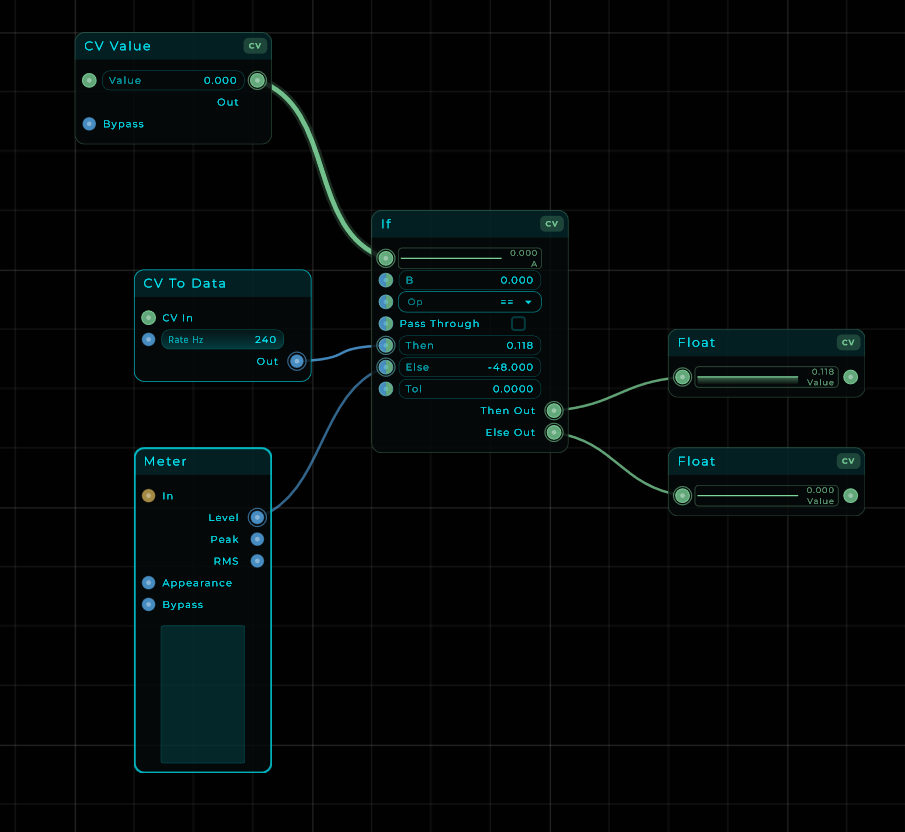
I have always worked with this, accepting the behavior but it never made sense to me why the A/B comparison dictates the then/else output to be CV or Data while you defined the input of THEN or ELSE as Data.
Is it possible to address this to make it more sense or is it creating a problem for backwards compatibility?
Hey! It’s by design, and every hybrid node works the same way (Float, Map, Math…). One CV cable into any of its inputs, not only A or B, switches the whole node to CV, so both outputs turn CV too.
The upside is that it checks on every sample, so the output flips exactly when A crosses B, in sync with your audio, and no quick change gets lost. As Data it would arrive late and could miss fast changes.
If you want the If to stay Data, put a CV To Data before A.
It isn’t about using it, I had to start the topic to see what’s the idea behind it because I feel there is some improvement to make.
So in general we could agree that this is a type-preserving compare switch. At least that’s how I see it.
Shouldn’t the input pins such as for the ELSE and THEN not switch to CV instead of offering CV and Data as input but only CV. Since the ELSE and THEN output pins are only CV.
Data thru ELSE and THEN is ending up as CV in that case. At least I tested that, which might be also intended before you added the data to CV node.
Oh and don’t worry about this to much I am just trying to figure out how you approach things.
Well, one thing is how the data comes out, and another is how it comes in.
Having hybrid inputs lets us use both worlds to feed a signal, which makes the node more flexible and convenient. Even if the output ends up being CV when the node receives a CV input, I designed it this way to avoid unnecessary conversions, keep things synchronized, and handle everything inside a single flexible node.
Also, if an output is CV, you can always convert it to Data and use it however you need. The opposite conversion ( Data to CV ) is generally less ideal when you need precise timing and values, because the thread that handles Data runs much slower.
 I am just trying to figure out how you approach things.
