I’d like a node similar to IsHex, but with bytes (or binary in general), so any text with a character other than 0 or 1 would be invalid. A couple of nodes to convert hex to binary and vice versa could also be useful. And a byte to bits and vice versa.
I have made a working 8x8 dot matrix display and I’d like to program it with a series of 8 bytes to control each individual pixel within a column. I’d like to create, for example, the letter ‘A’ from a bitmap composed of 8 bytes in a text file, read the bytes and send them to each respective column where they will set the individual bits within the column.
With byte support, you could conceivably build a Turing complete computer within MNodes and you could then do pretty much anything.
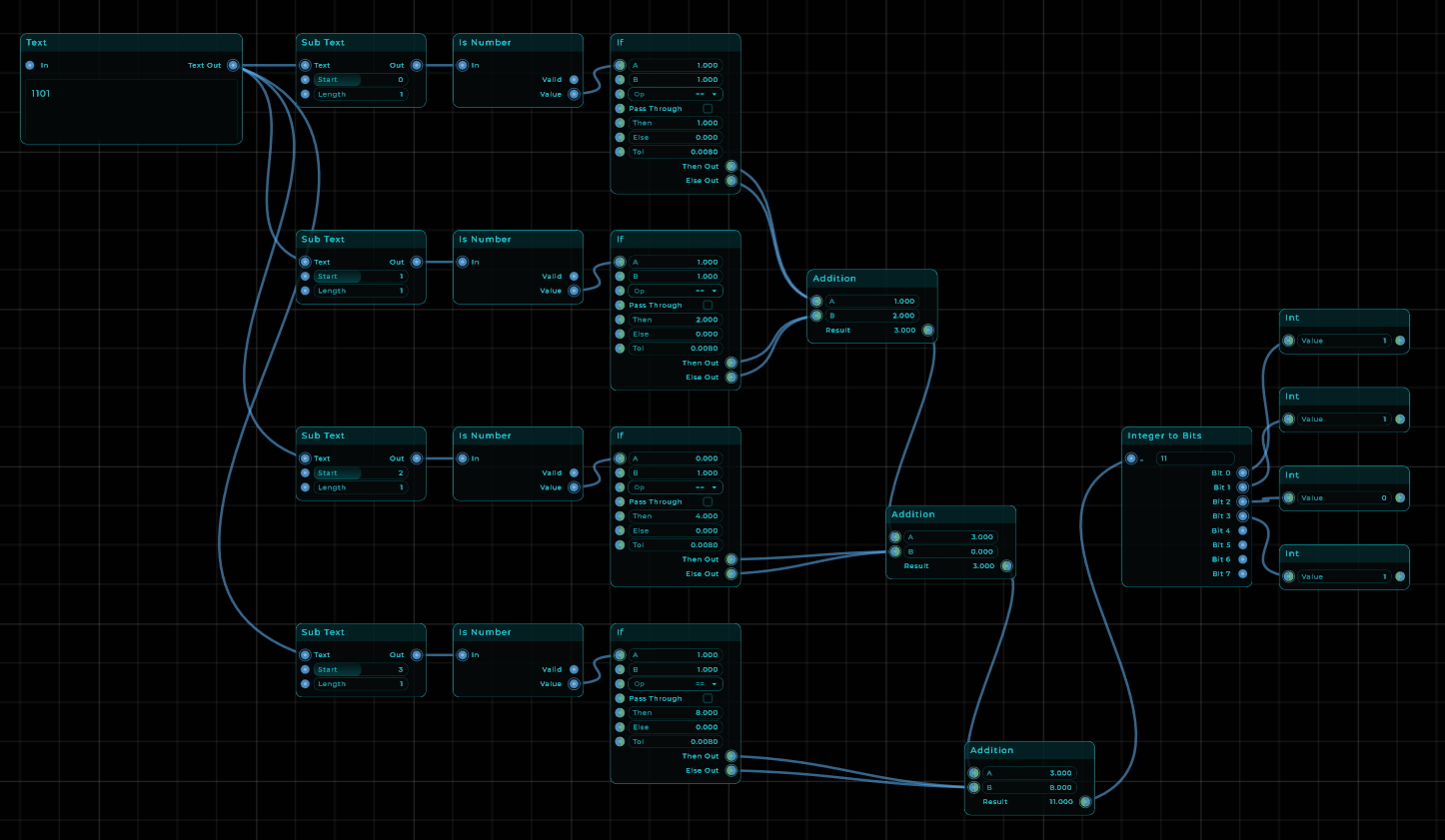
This is not a complete answer to solve it all, but this might be a piece of how to convert text to bits (it’s designed as an example, so i addressed only the 4 bits from text to a integer into the bit converter node.
While that is a nice graph that shows what’s doable with MNodes already I always wonder how efficient such a construct actually is? Because CPU always is a limiting factor.
Making a Module out of it would allow to re-use it all over the place. But how much overhead does it actually produce compared to a dedicated native node that handles bytes as requested?
Maybe an internal node compiler could make it as efficient as a native node. But do we already have such a low level compiler for nodes available to make such graphs highly efficient? @MarioNietoWorld - don’t think so?
Maybe it would help to have said compiler for nodes that could allow making graphs very efficient. I can image that a PianoRoll could not efficiently be compiled in such a scenario. But mathematical / logical nodes could be compiled this way maybe.
Perhaps there is a way to have such a compiler for dedicated calculation graphs. Or maybe an explicit code node that always allows efficient compilation.
Ah for these kind of functions, as i requested to get that integer to binary node and vice versa was not about the CPU performance, just about the useability for a lot of cases without having people to create them.
I think efficiency has some times it right place to be addressed and sometimes it’s just nothing to worry about.
You could see how much CPU it’s using, and you also can bypass it to exclude it from the processing. in this case efficiency can also be a designer (you/me) choice how to implement them.